
How to Manage Walking and Standing With Plantar Fasciitis
Heel pain is frustrating enough when you can rest. It is harder when you have a job that keeps you on your feet, a dog that needs walking, or errands you cannot put off. If you have plantar fasciitis, you may notice that the first steps hurt, things loosen up for a while, and then your heel aches again after a busy day.
You do not necessarily have to stop walking altogether. But repeatedly pushing through activities that make the pain worse can leave your heel more uncomfortable. The better approach is to make the amount of time on your feet more manageable, adjust what you can, and watch how your foot responds. The NHS plantar fasciitis guidance recommends avoiding long periods of standing or walking when they aggravate symptoms, while the American Academy of Orthopaedic Surgeons (AAOS) advises reducing activities that make the pain worse.
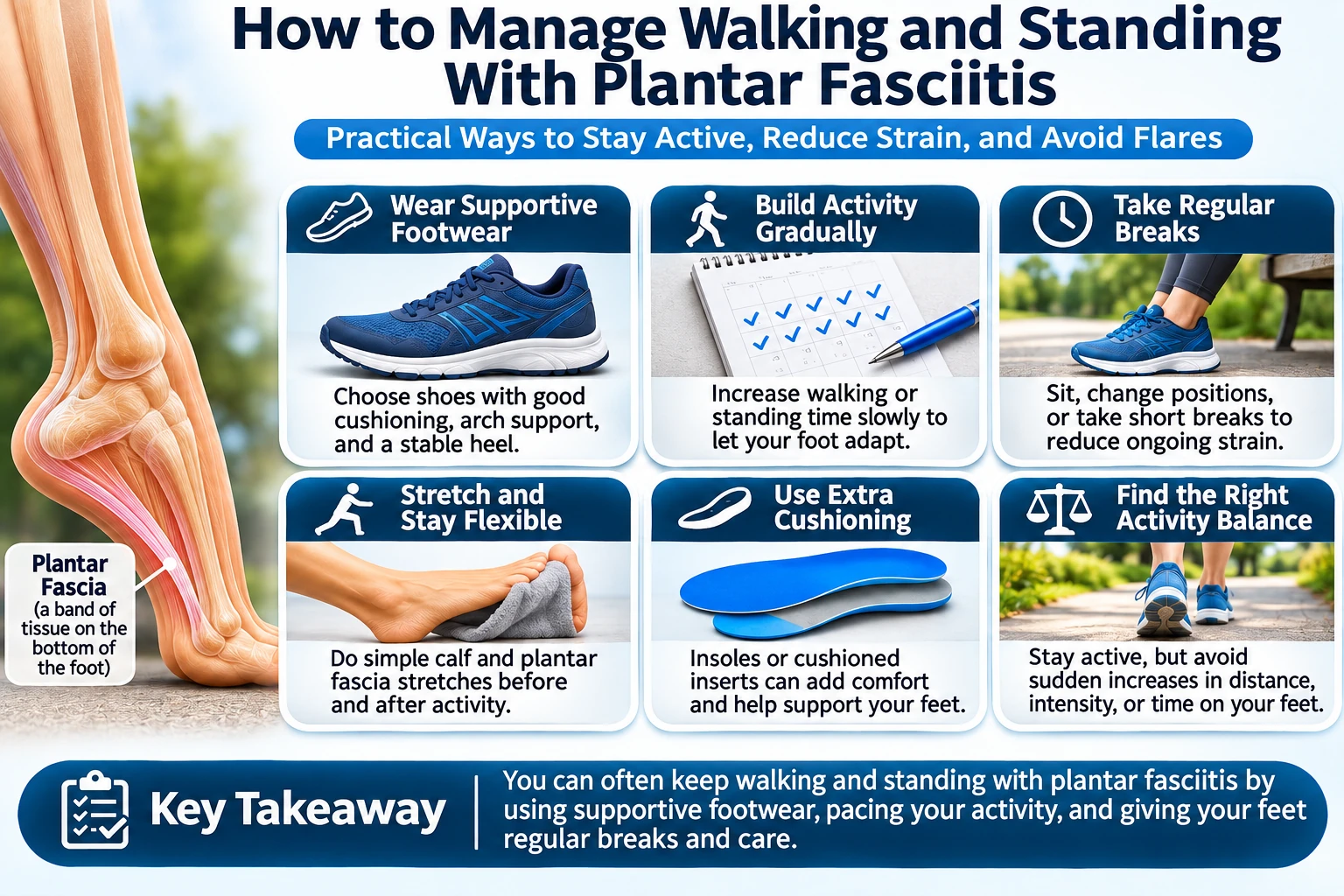
Can you keep walking with plantar fasciitis?
Often, yes—if the walking feels manageable and does not consistently leave you worse afterward. A short, comfortable walk is different from forcing yourself through several miles when every step hurts. There is no universal step-count limit that works for everyone.
Think about three points in your day: how the heel feels when you start, how it feels during the activity, and how it feels later that day or the next morning. If a walk seems fine at first but leaves you limping by evening or noticeably worse the next morning, that amount may be too much for now.
On the other hand, if you can take a modest walk without a significant increase in symptoms, you may be able to keep it in your routine. The aim is not complete inactivity; it is finding a level of movement your foot can currently handle. The AAOS treatment overview recommends adjusting aggravating activity and offers cycling or swimming as lower-impact alternatives.
Why standing still can be just as difficult
Walking gets most of the attention, but standing for long stretches can also be uncomfortable. A cashier, teacher, nurse, or factory worker may spend hours bearing weight even without taking many steps. The 2023 plantar heel pain clinical practice guideline includes work-related weight-bearing demands among the factors clinicians consider when evaluating plantar heel pain.
If you stand in one spot for much of the day, look for small opportunities to change position or take weight off your feet. Sitting briefly between tasks, alternating between standing and seated work when possible, or arranging supplies to reduce unnecessary trips may be more realistic than simply being told to rest.
These are practical ways to manage exposure, not proven cures. If your work makes breaks difficult, discuss reasonable task changes with your supervisor or occupational health team rather than waiting until the pain becomes unbearable.
Break up the time on your feet
If long stretches of walking or standing aggravate your heel, breaking them into shorter periods may make the day more manageable. You might try a ten-minute errand, sit for a few minutes, then decide whether your foot feels ready for the next task. Someone who works a long shift might aim to sit during an available break instead of spending the whole break standing in line.
There is no research-backed rule that everyone must rest after a specific number of minutes. Start with what your schedule allows, and compare how you feel on days with and without those breaks. If your heel becomes increasingly sore, shorten the next period on your feet instead of waiting for severe pain.
A simple activity note can help: “Thirty minutes shopping, heel sore afterward, worse first steps tomorrow.” That is more useful than trying to remember whether the entire day was good or bad. If your activity has increased recently, scale it back temporarily and build up again as your symptoms settle.
Make walking less demanding without buying everything
Before shopping for a new shoe or insole, look at what you already wear. Are your shoes worn down? Do they pinch? Is the heel cushioning flattened? Does walking barefoot on hard floors make the pain worse?
The NHS recommends shoes with cushioned heels and good arch support and advises against walking barefoot on hard surfaces when that aggravates symptoms. The AAOS also discusses supportive shoes and heel pads among conservative care options.
Try the simplest sensible change first. If a comfortable pair you already own makes the workday easier than flat, worn-out shoes, you have learned something useful without spending more money. If a shoe feels supportive but rubs, squeezes your toes, or changes your walking in an uncomfortable way, it is not a good choice simply because its label says “arch support.”
An inexpensive insert or heel pad may be worth considering when the fit allows it, but don't assume custom orthotics are automatically necessary. The 2023 clinical practice guideline advises against orthoses as the only treatment for short-term pain relief; they may be used alongside other care. Footwear can help with comfort, but it does not replace an appropriate activity and rehabilitation plan.
What if you work eight or twelve hours on your feet?
You may not be able to choose shorter shifts or stop walking whenever your heel hurts. In that situation, focus on changes that are actually available to you.
For example, a nurse might sit while charting when duties allow, keep frequently used supplies nearby, and use breaks to rest rather than walk extra laps. A retail worker might rotate to a seated task for part of a shift if the employer can accommodate it. Someone who stands at a workstation might discuss a stool or other workstation adjustment.
These adjustments are not guaranteed to solve plantar fasciitis. They are ways to reduce unnecessary strain while you work toward improvement. If you are regularly limping, struggling to complete your shift, or needing to change your gait to get through the day, arrange an assessment rather than simply buying stronger inserts.
How to return to longer walks
When your heel begins to feel better, it is tempting to make up for lost time. A good day, though, is not necessarily proof that your foot is ready for a long hike or a full day of sightseeing.
Start with a distance or duration you have recently managed comfortably. Repeat it on a few occasions, paying attention to later symptoms and the following morning. If it remains manageable, increase one thing at a time—such as walking duration—rather than adding distance, hills, speed, and extra days all at once.
If pain rises and stays worse afterward or the next morning, return to the last manageable level and allow symptoms to settle before increasing again. This is a practical pacing approach, not a precise medical progression schedule. If you are training for running or sport, a physical therapist can help tailor the return to your goals. The AAOS guidance supports reducing aggravating impact activities and using lower-impact options while symptoms improve.
Where stretching and strengthening fit
Walking changes alone may not be enough. The 2023 clinical practice guideline recommends plantar fascia and calf stretching for pain and function and supports resistance training for the foot and ankle.
A short, manageable routine may fit before work or after a break, but the exercises should be appropriate for your symptoms. Do not turn every pause in your day into an aggressive stretch session. If an exercise sharply increases pain or leaves you worse, modify it and ask a clinician or physical therapist for guidance. Detailed exercise technique belongs in our separate plantar fasciitis stretches and exercises article.
How to tell whether your plan is helping
Look for trends over a couple of weeks rather than judging one afternoon. Maybe you can finish grocery shopping without limping. Maybe your first steps after a work break are less uncomfortable. Maybe your heel settles sooner after a busy day.
Improvement is not always a straight line. A long shift, unexpected errand, or unusually active weekend may temporarily increase symptoms. A setback does not automatically mean you have undone all your progress. Use it as information about how much activity is currently manageable.
If the same amount of walking continues to cause more pain, or your ability to stand and work is shrinking, reassess the plan rather than repeatedly pushing through it.
When walking or standing pain needs medical attention
Heel pain is not always plantar fasciitis. Arrange a healthcare appointment if the pain is severe, getting worse, recurring, limiting ordinary activity, or not improving after about two weeks of self-care. The NHS also recommends assessment for tingling, loss of sensation, or foot pain in someone with diabetes.
Get prompt medical attention after a significant injury, if you cannot bear weight, or if you develop marked swelling, redness, fever, or other concerning symptoms. If you have been diagnosed with plantar fasciitis but the pattern changes substantially, do not assume the same explanation still applies.
A workable plan for tomorrow
Choose one change that fits your actual day. It might be a shorter walk, a seated break during a long shift, wearing your more comfortable shoes indoors, or swapping a high-impact workout for cycling. Keep everything else as consistent as practical and see how your heel responds.
You do not need to buy several products or stop moving completely to start making progress. The most useful plan is one you can follow at work, at home, and during ordinary errands—then adjust as your symptoms change.