
Plantar Fasciitis Treatment Options: What the Evidence Says
Heel pain has a way of making every treatment sound tempting. One person swears by stretching. Another says an expensive insert fixed everything. Then you see advertisements for injections, shockwave therapy, and devices that promise faster healing. How do you know what is worth trying?
For most people with plantar fasciitis, the best place to start is not the most expensive treatment. It is a consistent plan that reduces aggravating activity, restores comfortable movement, and builds the foot's ability to handle everyday demands. The 2023 plantar heel pain clinical practice guideline supports several hands-on and exercise-based treatments, while giving more limited recommendations for some popular products. The right combination depends on your symptoms, daily routine, and response over time.
This guide compares the major options, explains what the evidence can—and cannot—tell you, and helps you decide what deserves attention first. It does not replace a diagnosis: heel pain from a stress injury, nerve problem, or another condition may need a different plan.
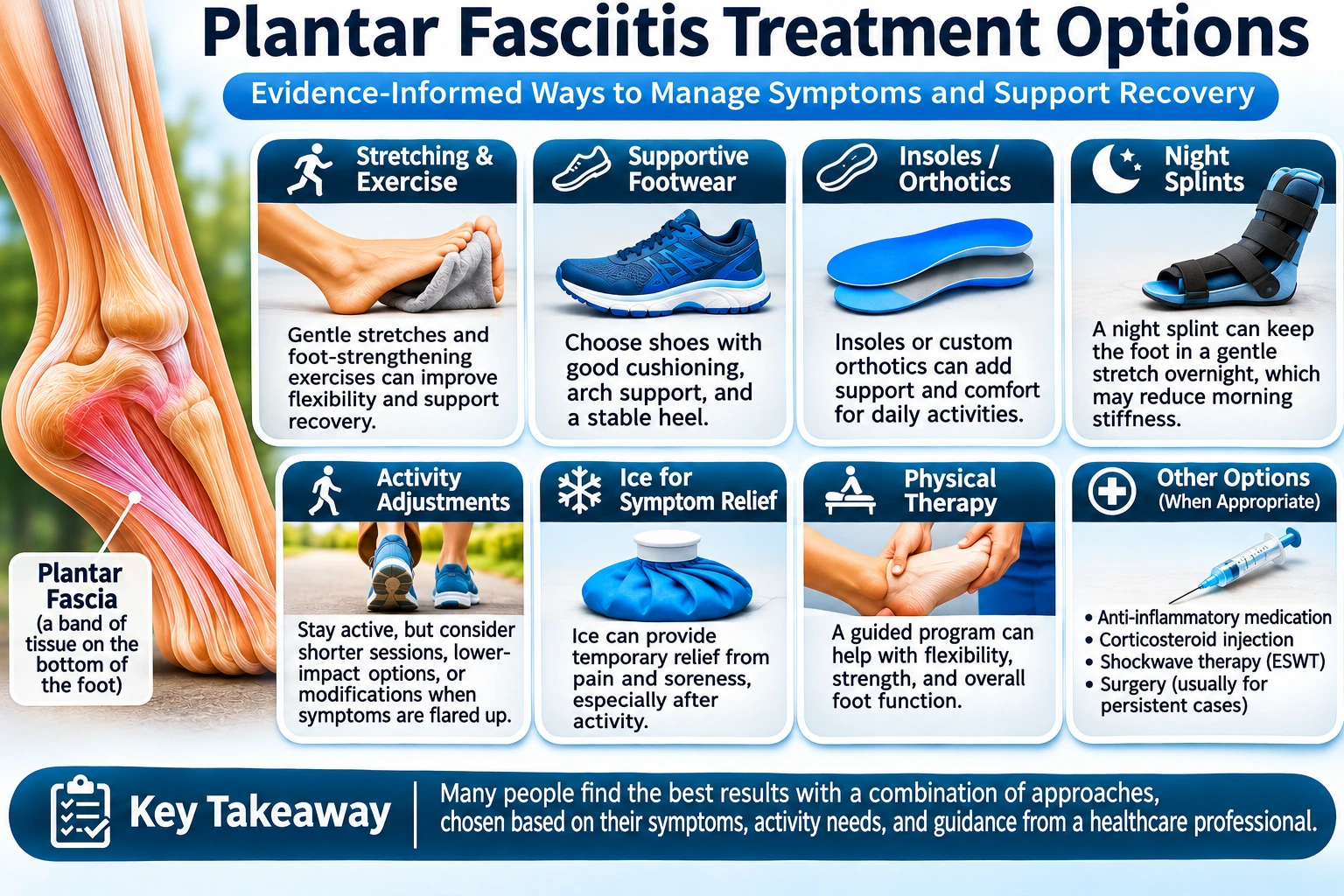
Start with a treatment plan, not a single product
Plantar fasciitis often hurts most with the first steps after rest and again after long periods on your feet. Treatment should address both parts of that problem: how the heel feels now and what it can comfortably tolerate as you return to normal activity.
A sensible starting plan usually combines a temporary reduction in activities that repeatedly trigger pain, appropriate stretching, and footwear that makes walking more comfortable. As symptoms allow, strengthening and a gradual return to activity can become part of the plan. The American Academy of Orthopaedic Surgeons (AAOS) describes activity changes, stretching, and nonsurgical care as common first steps.
You do not need to buy five treatments at once. If you change your shoes, start a splint, add an insert, and begin three new exercises on the same day, it becomes difficult to tell what is helping. Begin with a manageable routine, keep track of first-step pain and walking tolerance, and make changes deliberately.
Stretching: one of the strongest starting options
Stretching the plantar fascia and calf muscles is among the better-supported conservative treatments. The 2023 clinical guideline recommends plantar fascia-specific stretching and stretching of the gastrocnemius and soleus calf muscles to improve pain and function.
The distinction matters. A plantar fascia stretch targets the tissue beneath the foot, while calf stretches address muscles and ankle movement that can influence how the foot handles walking. One does not automatically replace the other.
For someone with sharp first-step pain, a gentle plantar fascia stretch before getting out of bed may be a practical place to begin. Someone who also has limited ankle flexibility may benefit from calf stretching as well. The goal is a tolerable, repeatable routine—not forcing the heel into pain to prove the stretch is working.
Stretching is useful, but it is not an overnight cure. Give a reasonable, consistent program time to work, and adjust it if it repeatedly makes symptoms worse. Detailed technique and progression belong in our dedicated plantar fasciitis stretches and exercises article.
Strengthening: helping the foot handle more work
Stretching addresses flexibility; strengthening addresses the foot and ankle muscles' ability to manage load. The 2023 guideline supports resistance exercise for the foot and ankle muscles as part of treatment.
Depending on your current tolerance, that might involve controlled heel raises or other therapist-selected exercises. If ordinary walking is already very painful, jumping straight into heavy calf raises may be too much. A gentler starting level and gradual progression make more sense.
A physical therapist can be especially helpful if you are unsure which movements to choose, keep having setbacks, or need to return to a physically demanding job or sport. The point is not to collect as many exercises as possible. It is to build a routine you can actually continue.
Activity changes: reducing irritation without giving up movement
If a long run, a work shift, or several hours on hard floors consistently leaves your heel worse, that is useful information. Temporarily reduce the part of your routine that causes repeated flare-ups, then work back toward it as symptoms improve.
The AAOS treatment overview suggests lower-impact activities such as cycling or swimming when impact exercise aggravates the heel. The NHS self-care guidance also recommends limiting prolonged standing or walking when these are painful.
That does not mean everyone needs complete rest. For many people, shorter walks, breaks during long shifts, and avoiding sudden increases in distance are more practical than stopping all movement. Judge the plan by the overall trend, including how the heel feels the next morning—not just whether you can push through an activity today.
Shoes, heel pads, and insoles: useful support, not a cure
Comfortable footwear can make a meaningful difference to day-to-day symptoms. Shoes with appropriate fit, cushioning, and support may be easier to tolerate than worn-out footwear or barefoot walking on hard floors. The NHS recommends cushioned, supportive shoes and suggests insoles or heel pads as self-care options.
Orthotics deserve a more careful distinction. The 2023 clinical guideline advises against using prefabricated or custom orthoses as an isolated treatment for short-term pain relief. It allows them as part of a broader treatment program. That is not the same as saying inserts never help; it means an insert should not replace the rest of your plan.
If your current shoes are comfortable and your symptoms are improving, you may not need to buy anything. If hard floors or a particular pair of shoes consistently aggravate your heel, trying a reasonably priced supportive option may be sensible before paying for custom orthotics. There is no credible reason to assume the most expensive insert will be best for every foot.
Taping and hands-on physical therapy
Foot taping can provide short-term symptom relief while you work on longer-term changes. The 2023 guideline recommends taping alongside other physical therapy treatments for short-term improvements in pain and function.
Manual therapy—hands-on treatment of relevant joints and soft tissues—is also recommended in that guideline when a clinician identifies movement or flexibility restrictions. These treatments can help some people participate more comfortably in a broader rehabilitation plan.
Neither should be mistaken for a permanent mechanical fix. If taping helps during a long shift, that may be useful while you work on load tolerance and exercise. If it does nothing, there is little reason to keep applying it out of habit. A therapist can help select and demonstrate appropriate techniques.
Night splints: most relevant for stubborn first-step pain
Night splints hold the ankle and foot in a position intended to reduce the tightening that can make the first morning steps painful. They are not a default purchase for every sore heel.
The 2023 clinical guideline recommends a one- to three-month night-splint program for people who consistently experience first-step morning pain. That recommendation is aimed at a particular symptom pattern, not everyone with plantar fasciitis.
A splint can also interrupt sleep or feel awkward. If your main problem is pain after an eight-hour standing shift rather than first-step pain, it may not be the most logical first purchase. Discuss persistent morning symptoms and whether a splint fits your treatment plan before spending money on one.
Ice and pain medicine: symptom relief has a role
Ice may help settle a painful heel after activity, and over-the-counter pain medicines may provide temporary relief for some people. The NHS includes wrapped ice packs and common pain relievers among its self-care options.
These measures may make daily life more manageable, but they do not by themselves restore strength, change an aggravating activity pattern, or confirm the diagnosis. Use medicines according to their labels and ask a pharmacist or clinician if you have conditions, take other medicines, or are unsure whether a pain reliever is appropriate. Do not put ice directly against bare skin.
Think of symptom relief as support for a sensible recovery plan—not evidence that the underlying problem is solved just because the pain is temporarily quieter.
Shockwave therapy, injections, and other procedures
If symptoms persist despite a sustained nonsurgical plan, a clinician may reassess the diagnosis and discuss additional options. These are not interchangeable upgrades, and each has different evidence, costs, and risks.
Extracorporeal shockwave therapy (ESWT) uses sound-wave pulses applied to the painful area. It is noninvasive, but study results and treatment protocols vary. The AAOS describes mixed results and notes that it may be considered before surgery in selected persistent cases. It is not a guaranteed fix.
Corticosteroid injections may reduce pain, sometimes for a limited period, but they also carry risks. AAOS notes that steroid injections can weaken the plantar fascia and contribute to rupture. That tradeoff matters, especially when someone is considering repeat injections simply to stay active. A clinician should discuss expected benefit, alternatives, and risks for your situation.
Platelet-rich plasma (PRP) and other injection treatments are sometimes offered for stubborn cases. Availability and pricing can be very different from standard physical therapy, and the evidence does not justify promising a predictable result. AAOS notes that PRP can be expensive and that more research is needed to establish its effectiveness. Ask what outcome the treatment is expected to improve, what the supporting evidence shows, and what you would do if it does not help.
Surgery is usually a last resort, not the next step after trying a pair of insoles. The AAOS treatment overview describes surgery as generally reserved for persistent symptoms after an extended course of nonsurgical care. Surgery involves recovery time and possible complications, so it calls for a careful discussion of the diagnosis, likely benefits, and alternatives.
How to choose what to try next
If you are newly dealing with typical plantar fasciitis symptoms, start with a manageable combination of activity adjustment, appropriate stretching, and comfortable footwear. If you can follow that plan consistently, you may not need to add a device or procedure right away.
If morning first-step pain remains your biggest obstacle, ask whether plantar fascia stretching and, in selected cases, a night splint are worth emphasizing. If you can manage short walks but flare after long shifts, focus on pacing, breaks, and footwear before assuming you need an injection. If your symptoms have persisted despite a consistent plan, a physical therapist or other qualified clinician can reassess your diagnosis and help decide whether to change the program.
The AAOS reports that more than 90% of people improve within 10 months of starting simple treatment. That is encouraging, but it is not a deadline or a promise about any one person's recovery. Improvement can be uneven. Track first-step pain, tolerance for everyday walking, and how quickly the heel settles after activity rather than judging the plan by a single day.
When to get your heel checked
Arrange a medical assessment if heel pain is severe, getting worse, keeps returning, or has not improved after about two weeks of self-care. Tingling, numbness, or foot pain when you have diabetes also deserves assessment, as the NHS advises. Sudden pain after an injury, inability to bear weight, major swelling, or signs of infection call for prompt attention.
The best treatment for plantar fasciitis will not solve heel pain caused by a stress fracture, nerve problem, or another condition. If the pattern is unusual or progress stalls, checking the diagnosis may be more useful than buying another product.