
Orthotics and Insoles for Plantar Fasciitis: Do They Help?
When your heel hurts every morning, a new pair of insoles can seem like the simplest fix. You slide them into your shoes, get a little more cushioning or arch support, and hope the pain fades. Some people do feel more comfortable with an insert. Others spend money on one pair after another and wonder why their heel still hurts. The difference isn't always the price or the brand. It's whether the insert addresses a problem you're actually having—and what else you're doing to help your foot recover.
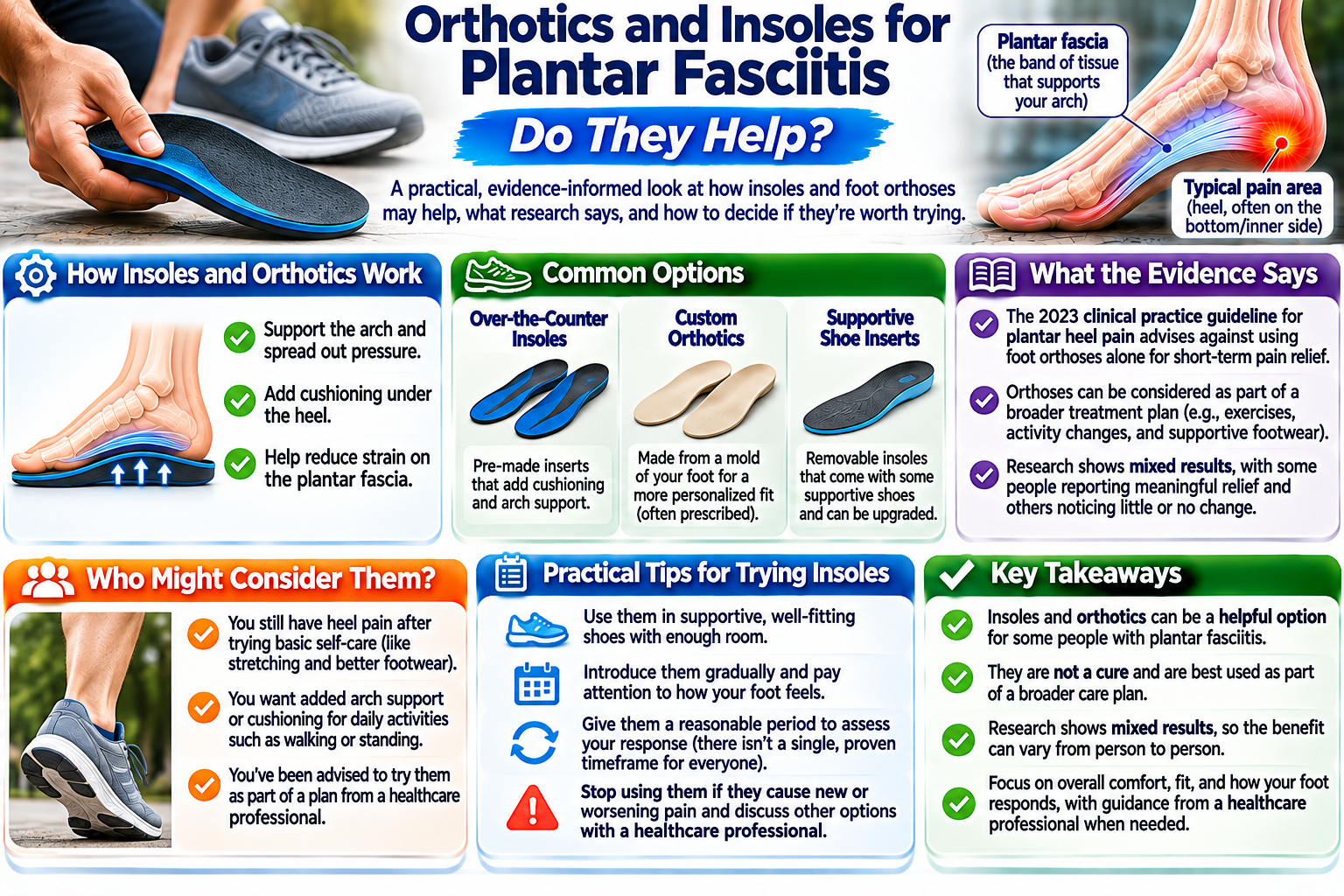
Orthotics and insoles can be useful for some people with plantar fasciitis, but they are not a stand-alone cure. The 2023 plantar heel pain clinical practice guideline advises clinicians not to use foot orthoses alone for short-term pain relief. It does allow them as part of a broader treatment plan. That distinction matters: an insert may make standing and walking more tolerable while stretching, strengthening, and activity changes address the bigger picture. Read the 2023 guideline.
Before buying anything, it helps to understand what an insert can realistically change, how to choose between inexpensive and custom options, and when heel pain calls for a closer look instead of another purchase.
What a Plantar Fasciitis Insole Can and Cannot Do
The plantar fascia is a strong band of tissue running along the underside of the foot from the heel toward the toes. It helps support the arch as you stand and walk. With plantar fasciitis, pain often sits near the inner underside of the heel and can be particularly noticeable during the first steps after rest. Our plantar fasciitis overview explains that pattern and the broader treatment options.
An insole changes the surface your foot meets inside the shoe. Depending on its shape and materials, it may redistribute pressure, add cushioning beneath the heel, or provide a different feeling of support under the arch. For someone who spends hours standing on hard floors, that change can make a workday more manageable. But an insert doesn't automatically correct the reason heel pain developed, and feeling better in one doesn't prove plantar fasciitis was the diagnosis.
Imagine two people with similar morning heel pain. One has a pair of worn-out shoes with flattened cushioning and feels better after switching to comfortable footwear with a simple insert. The other already wears well-fitting shoes but has recently doubled their running mileage. More arch support may not solve the second person's main problem: the sudden increase in activity. That's why it makes sense to think about footwear and activity together rather than treating the insole as the whole plan.
The American Academy of Orthopaedic Surgeons (AAOS) includes supportive footwear and orthotic inserts among nonsurgical options, alongside stretching and changes to aggravating activity. For a reader choosing between an insert and a complete shoe replacement, that distinction is useful: focus first on what makes walking uncomfortable, then choose the smallest sensible change.
What the Research Says About Orthotics for Plantar Fasciitis
This is where marketing claims often get ahead of the evidence. A product page may promise that a particular arch shape or heel cup will correct plantar fasciitis. Clinical research asks a more modest question: does an orthosis improve pain or function, and how does it perform when used alone or with other care?
The 2023 clinical practice guideline recommends against prescribing foot orthoses, either prefabricated or custom-made, as an isolated treatment for short-term pain relief. It also says orthoses may be used with other treatments to reduce pain and improve function. The two recommendations answer different questions. An insert may contribute to a treatment plan, but evidence does not support treating it as the entire plan for short-term relief.
That same guideline supports plantar fascia and calf stretching and foot and ankle resistance exercises. Think of an insert as something that might make daily movement easier while you work on those other parts of recovery. If you can stand comfortably enough to get through a shift, that matters. But if a weekend hike repeatedly leaves you limping the next morning, the amount of activity still needs attention, regardless of what is inside your shoes.
Research findings also vary by the type of orthosis, the comparison treatment, the outcome measured, and how long people are followed. So a study reporting an improvement doesn't guarantee that the most expensive insert—or any insert—will work for you. Be especially skeptical of claims that one design permanently realigns the foot or cures plantar fasciitis within days.
Custom Orthotics vs. Over-the-Counter Insoles for Plantar Fasciitis
Custom orthotics sound more precise because they're made from a scan, mold, or other measurements of your feet. They may be appropriate when a clinician identifies a particular fitting or biomechanical need, when standard products cannot accommodate the foot, or when a more complex problem requires individualized management. But custom manufacturing does not automatically translate into better plantar fasciitis outcomes for everyone.
Over-the-counter inserts are usually less expensive and easier to try. They come in different lengths, arch profiles, and levels of cushioning. A suitable prefabricated insert may be enough when the goal is simply to make an otherwise comfortable shoe feel better underfoot. The 2023 guideline's caution about orthoses used alone applies to both custom and prefabricated options; it should not be interpreted as an endorsement of costly custom devices over ordinary inserts. See the guideline.
Consider someone whose walking shoes fit well, but whose heel becomes uncomfortable during a long shift. Trying a modestly priced insert that fits those shoes may be reasonable before spending substantially more on custom orthotics. Now consider someone with an unusual foot shape, substantial deformity, or repeated pressure problems. That situation is less suited to trial-and-error shopping and more suited to a clinician's fitting assessment.
So the useful comparison is not simply custom versus cheap. First ask whether an insert is needed at all. If it is, ask whether a well-fitting standard option meets that need. A custom device becomes more compelling when a clinician identifies a specific reason a standard one may not work.
Arch Support, Heel Cushioning, and Fit: What Actually Matters?
An insert can feel supportive without being comfortable, and a soft insert can feel pleasant for five minutes but disappoint during a full day of walking. There isn't one universally ideal arch height or firmness for plantar fasciitis. The right combination depends on your shoes, foot shape, comfort, and what seems to aggravate the heel.
Arch support changes how the underside of the foot contacts the insert. Some people prefer a noticeable contour; others find aggressive pressure under the arch irritating. Heel cushioning may make hard surfaces feel less harsh, particularly when pressure directly under the heel is uncomfortable. But a deep, bruise-like pain in the center of the heel can also suggest heel-pad problems rather than classic plantar fasciitis. An insert that feels better is not a diagnostic test.
Fit matters just as much as the insert's features. Adding a thick insole to a snug shoe can crowd the toes, raise the heel against the shoe collar, or make the foot feel unstable. If the original removable liner can be taken out, check whether the new insert is intended to replace it rather than sit on top. Make sure your heel stays secure and your toes still have room. An insert that forces you into a poorly fitting shoe is not a useful upgrade.
If a new insert causes sharp pain, numbness, rubbing, or a steadily worsening pattern, stop using it and reconsider the fit. Don't assume discomfort means the orthotic is “correcting” your foot and must be endured.
When Buying an Insole May Be Worthwhile
A purchase makes more sense when you can identify what you want it to improve. Perhaps your work shoes are otherwise comfortable but feel harsh on concrete. Perhaps a removable liner has flattened, or a modest amount of arch contour makes walking easier without adding pressure. In those situations, an appropriate insert may be a practical experiment—not a commitment to buying a premium medical device.
Try to change one thing at a time. If you buy new shoes, new insoles, and a night splint while also changing your exercise routine, you may feel better without knowing which change mattered. Keep the rest of your routine reasonably consistent, and pay attention to how the foot responds during ordinary activities and the following morning.
An insert is less compelling when your current footwear is comfortable and your symptoms are already steadily improving. It may also be the wrong next step if the pain is mainly behind the heel, follows an injury, includes burning or numbness, or becomes progressively worse with weight-bearing. Those patterns deserve consideration beyond the usual plantar fasciitis shopping advice.
When Shoes Matter More Than Insoles
An insert cannot rescue every shoe. If the shoe is badly worn, unstable, too narrow, or painful around the heel, adding support inside may simply create a new fit problem. Sometimes a well-fitting pair of shoes is the more sensible change. Other times, replacing shoes that already work would be unnecessary spending.
Think about how you actually use the footwear. A person who walks several miles a day needs a shoe-and-insert combination that stays comfortable over distance. Someone who stands at a counter for most of a shift may care more about sustained comfort on a hard surface. A runner needs to consider training load and whether a new insert changes the feel of a familiar running shoe. The same product will not solve every situation.
If you reach the point of comparing products, focus on the features that matter for your own shoes and daily activities. Product rankings are much more useful after you know whether the problem is shoe fit, heel cushioning, or the need for a different kind of support. For readers still working out whether the pain is plantar fasciitis, the main condition guide is a better next stop than a shopping list.
How to Tell Whether an Insole Is Helping Your Plantar Fasciitis
You don't need to judge an insert by whether your heel feels perfect the first time you wear it. More useful questions are whether you can complete familiar activities with less discomfort, whether the first steps the next morning are easier, and whether the insert creates any new pressure or rubbing.
Compare similar days rather than an easy Sunday with a twelve-hour shift. If you normally walk around the same neighborhood, notice how your heel feels during that walk and later that evening. If you stand for work, think about whether the same part of the shift remains difficult. A short note once or twice a week is enough to identify a trend without turning recovery into a full-time project.
If an insert is comfortable and seems to help, it can remain one part of your plan. If it makes no meaningful difference, you don't need to keep upgrading to increasingly expensive models. Revisit the diagnosis, activity demands, and rehabilitation approach rather than assuming the next purchase will finally fix everything.
Why Orthotics Should Be Part of a Broader Treatment Plan
Plantar fasciitis often improves with nonsurgical care, but recovery may take time. The AAOS plantar fasciitis guide discusses stretching, adjusting painful activities, footwear, and other conservative options. The 2023 guideline likewise places orthoses alongside other interventions rather than treating them as the entire solution.
This matters because symptom relief and long-term activity tolerance are connected but not identical. An insert may make standing more comfortable today. Building a manageable stretching and strengthening routine and avoiding repeated jumps in activity may be equally important to how your foot handles next week. You don't have to do everything at once, but the plan should make sense beyond the shoe itself.
If you're unsure what to prioritize, start with the simplest changes you can maintain and consider working with a clinician or physical therapist when pain persists. A simple plan you can follow consistently is more useful than a drawer full of inserts you stopped wearing.
When Heel Pain Needs Medical Assessment Instead of Another Insert
Not every painful heel is plantar fasciitis. Arrange an assessment if pain is severe, keeps returning, is worsening, interferes with normal activities, or has not improved after about two weeks of reasonable self-care. The NHS plantar fasciitis guidance also advises medical assessment for tingling or loss of sensation and for foot pain in someone with diabetes.
Seek urgent evaluation after a significant injury if you cannot bear weight, or if the foot becomes markedly swollen or deformed. A hot, red, swollen foot with fever or other signs of infection also needs prompt attention. An insert should never be used to delay evaluation of those symptoms.
People with diabetes, reduced sensation, circulation problems, or existing foot wounds should be especially careful about prolonged pressure from new footwear or inserts. Get individualized advice about fit and skin safety rather than experimenting with aggressive arch support on your own.
Common Questions About Orthotics and Insoles for Plantar Fasciitis
Do insoles actually help plantar fasciitis?
Are custom orthotics better than store-bought insoles?
Should a plantar fasciitis insole feel firm or soft?
Can an insole cure plantar fasciitis on its own?
Do I need insoles if my shoes already feel supportive?
How long should I try an insole before deciding whether it helps?
Choosing Your Next Step With Plantar Fasciitis Insoles
If your shoes already fit well and your heel is gradually improving, you may not need to change anything inside them. Give the recovery plan you can comfortably follow time to work. If one otherwise comfortable pair leaves your heel sore on hard floors, a reasonably priced insert that fits properly may be worth trying. You can judge it by familiar walks or workdays rather than by how impressive it feels in the store.
And if your feet need an unusual fit, you keep developing pressure spots, or the pain does not match typical plantar fasciitis, that is a reason to ask a clinician for a more individualized assessment—not to keep moving up the price ladder. The best choice is not necessarily a custom orthotic, a store-bought insole, or a new shoe. Sometimes it is no purchase at all. What matters is whether the next step solves a real problem and helps you move more comfortably without overlooking the cause of the pain.