
Heel Pain: Plantar Fasciitis or Something Else?
Heel pain has a way of turning ordinary things into calculations. You start thinking about the walk from the parking lot, whether you can stand through a shift, or how much those first steps out of bed are going to hurt. If you've searched for an explanation, plantar fasciitis probably came up quickly. It's common, but it isn't the only reason a heel can hurt.
A sore heel can come from the plantar fascia beneath your foot, the cushioning pad under the heel bone, a tendon behind the ankle, a nerve, or even the heel bone itself. Those problems can feel surprisingly similar at first. The important differences often emerge when you consider exactly where the pain sits, when it shows up, and how it changes as you move. Clinicians use those clues, along with an examination, to narrow down the possibilities. The American Family Physician review of heel pain describes this location-based approach.
This guide will help you make sense of those patterns without trying to diagnose yourself. It will also explain when watching and adjusting your activity may be reasonable—and when the safest next step is to get your heel examined rather than buy another shoe or insole.
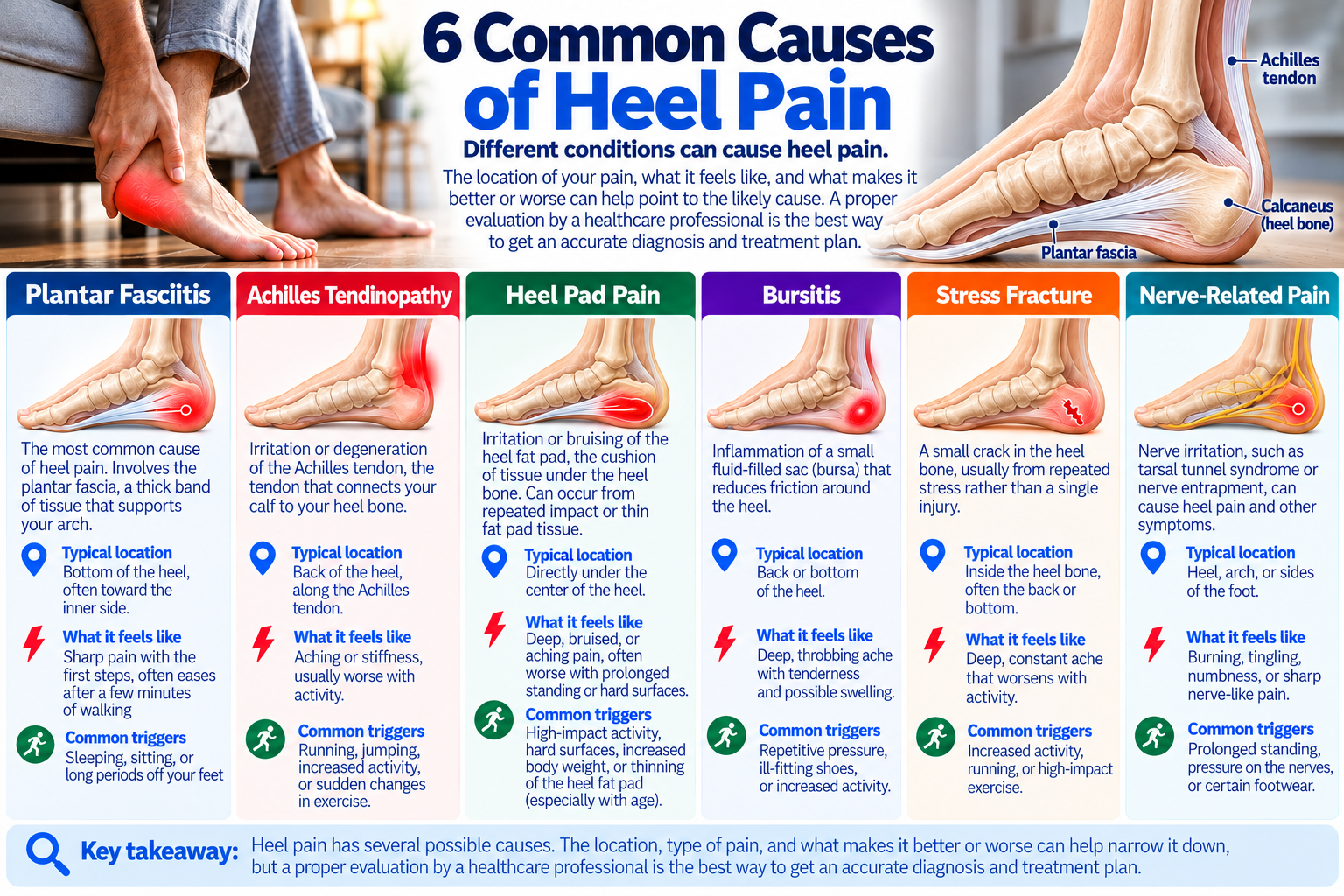
Start With Where Your Heel Hurts
Picture the underside of your foot. Pain near the inner edge of the heel, particularly after you've been resting, often raises the possibility of plantar fasciitis. Move that pain to the very center of the heel, where it feels as though you're stepping on a bruise, and the cushioning pad becomes a more relevant possibility. Pain at the back of the heel shifts attention toward the Achilles tendon or tissues around its attachment.
Location isn't the whole story, though. A nerve problem can produce burning or tingling that spreads toward the arch or toes. A stress injury in the heel bone may begin as activity-related soreness and become harder to ignore with continued loading. Sometimes more than one problem is present, and pain does not always stay neatly inside one area.
Rather than matching one symptom to a label, use the location as your starting point. Then ask what happens during the first few steps, during a longer walk, and after you've stopped. That combination is more informative than any single detail. The AAOS discussion of heel pain explains why pain beneath the heel and pain behind it often lead to different examinations.
Signs Your Heel Pain May Be Plantar Fasciitis
One of the most recognizable patterns is a sharp or aching pain under the heel when you first stand in the morning. The first several steps may be the worst. After you move around, the pain sometimes eases, only to return after prolonged standing, a long walk, or time spent sitting again. The sore spot is often closer to the inner underside of the heel than to its center.
Why would rest make those first steps uncomfortable? The plantar fascia is a strong band of tissue that helps support the arch and responds to the demands of standing and walking. When it is painful, loading the foot after a period of rest can bring the discomfort into focus. That familiar pattern is helpful, but it doesn't prove plantar fasciitis. A clinician also considers tenderness, ankle movement, recent activity changes, and other possible causes. The AAOS plantar fasciitis guide describes the typical symptoms and examination findings.
For example, someone who feels a sharp jab with their first steps, then manages a short morning walk reasonably well, has a different story from someone whose heel becomes progressively more painful the farther they walk. Both deserve attention, but they do not necessarily point to the same tissue.
If this first-step pattern sounds familiar, our plantar fasciitis overview explains the condition and the usual first steps in managing it. Keep reading here if the pain is somewhere else, feels unusual, or doesn't behave like the familiar pattern.
Heel Pad Pain vs. Plantar Fasciitis: When the Heel Feels Bruised
Imagine walking barefoot across a hard kitchen floor and feeling as if the bone in your heel is striking the tile directly. People with heel fat-pad pain often describe something close to that: a deep, bruise-like ache under the center of the heel. It may be particularly noticeable with repeated impact or long periods on firm surfaces.
The fat pad is the natural cushioning tissue beneath the heel bone. Its job is different from the plantar fascia's role in supporting the arch. When that cushioning area is painful, the complaint may center on pressure directly under the heel rather than the classic inner-heel, first-step discomfort. The American Family Physician heel-pain review describes this distinction.
There is overlap, of course. Plantar fasciitis can hurt during standing, and heel pad pain can be uncomfortable after rest. A cushioned shoe or heel cup may make pressure more tolerable for some people, but feeling better in a cushioned shoe doesn't establish which condition you have. If the discomfort persists or begins changing the way you walk, a proper examination is more useful than repeatedly experimenting with inserts.
Pain Behind the Heel: Achilles Tendon Problems and Bursitis
Pain behind the heel tells a different story. The Achilles tendon runs down from the calf and attaches to the back of the heel bone. If that tendon is irritated, you may feel stiffness or soreness behind the ankle or close to the attachment, especially during activities that demand more from the calf—such as hills, stairs, running, or pushing off the ground.
But the Achilles isn't the only structure back there. Small fluid-filled sacs called bursae help reduce friction around moving tissues. Irritation of a bursa near the back of the heel can produce localized tenderness or swelling, and pressure from the rigid back of a shoe may make it especially uncomfortable. The NHS heel-pain guidance describes common heel-pain patterns, including Achilles-related pain and bursitis.
The practical difference is that changing arch support alone may do very little for pain caused by a tendon or bursa behind the heel. A clinician can examine the precise location, look for swelling, and assess which movements reproduce symptoms. That helps guide the next step instead of treating every heel problem as plantar fasciitis.
There is one situation not to wait on: a sudden pop or snap near the Achilles, followed by pain or difficulty pushing off, may indicate a significant injury. Seek urgent medical assessment rather than trying to stretch through it.
Heel Pain That Builds During Activity: Consider a Stress Injury
Suppose you've recently increased your running distance or started walking much farther than usual. At first, your heel aches only toward the end of the outing. Over the next several days, the discomfort starts earlier. Eventually, even an ordinary walk becomes painful. That steadily worsening pattern deserves a closer look.
A stress injury happens when repeated loading exceeds the bone's ability to recover. In the heel, a calcaneal stress fracture is one possibility. Unlike the typical first-step pattern of plantar fasciitis, pain from a stress injury may become more noticeable as weight-bearing continues, and more advanced symptoms can linger after activity or at rest. The American Family Physician review discusses calcaneal stress fractures among the causes of heel pain.
You cannot confirm or rule out a stress fracture by pressing on your heel at home. Early X-rays may not show every stress injury, so a clinician may consider additional imaging if the history and examination raise concern. If pain is progressively worsening with walking or impact, don't keep testing it with longer walks or assume that firmer insoles will solve the problem. Arrange an evaluation and reduce aggravating impact while you wait for guidance.
Burning, Tingling, or Numbness: When Nerves May Be Involved
Not all heel pain feels like a bruise or a sore tendon. Some people describe burning, electric shocks, pins and needles, or a patch of numbness. The sensation may travel toward the arch, along the inner ankle, or into the toes. Those details shift attention toward possible nerve involvement.
One example is tarsal tunnel syndrome, which involves irritation or compression of a nerve near the inner ankle. Other nerves around the heel can also be affected. This doesn't mean every burning sensation is a trapped nerve, and nerve symptoms can overlap with other conditions. But the difference matters: a problem involving sensation needs more than a generic plantar fasciitis shopping checklist. The American Family Physician differential-diagnosis review describes nerve-related causes of heel pain.
If numbness or tingling is new, persistent, or getting worse, arrange an assessment. A clinician can examine sensation and strength and decide whether further evaluation is needed. In the meantime, avoid treating a changing sensory symptom as proof that you simply need more arch support.
Heel Pain in Children and Teenagers Is Different
A child who plays soccer or runs track may complain of pain near the back of the heel after practice. It is tempting to apply the same plantar fasciitis advice used for adults, but growing feet bring different possibilities.
One is Sever disease, also called calcaneal apophysitis, which affects the growth area at the heel and is associated with activity during childhood and adolescence. It is not the same as adult plantar fasciitis. A clinician familiar with pediatric injuries can assess persistent heel pain, especially when it changes how a child runs or walks. The American Family Physician heel-pain review includes this condition in the evaluation of younger patients.
Does a Heel Spur Explain the Pain?
A heel spur sounds like something that ought to hurt. It is a bony growth that can appear on an X-ray, and seeing one may make it tempting to blame every step on that finding. The problem is that heel spurs can appear in people who have no heel pain at all.
A spur can coexist with plantar fasciitis, but its presence does not automatically identify the source of pain or mean surgery is needed. The AAOS explanation of plantar fasciitis and heel spurs makes that distinction. Your symptoms and examination still matter more than an isolated image finding.
How to Make Sense of Your Heel Pain Before an Appointment
You don't need to perform painful tests or build a complicated symptom diary. A few observations from an ordinary day can make the picture clearer.
Think about two people with heel pain. One gets a sharp ache under the inner heel on rising, feels somewhat better after moving, then notices discomfort after a long shift. The other feels fine for the first part of a walk but develops increasingly intense heel pain the longer the walk continues. Those stories aren't diagnoses, but they give a clinician different reasons to investigate.
For a few days, notice where your heel hurts, when it hurts, and what kind of sensation you feel. Does it start after rest, during movement, or afterward? Is it sharp, bruised, burning, or numb? Has your walking distance, work schedule, training, or footwear changed? Most importantly, is it improving, staying the same, or interfering more with your normal activities?
You can jot down a few sentences and bring them to your appointment. The goal isn't to become your own diagnostician. It's to give the person examining your foot a useful story instead of simply saying, “My heel hurts.”
When Heel Pain Needs Medical Attention
Some heel pain is mild enough that a short period of sensible activity adjustment and comfortable footwear may be reasonable. But not every pattern is safe to monitor on your own.
Seek urgent medical assessment after a significant injury if you cannot bear weight, the foot looks deformed, you have severe pain or major swelling, or you felt a sudden pop and now have trouble pushing off. A hot, red, swollen foot with fever also warrants prompt assessment for possible infection.
For heel pain that is worsening, keeps returning, limits daily activities, or has not improved after about two weeks of self-care, arrange a medical appointment. New numbness or tingling should also be evaluated. If you have diabetes and develop foot pain, get medical advice rather than assuming it is ordinary plantar fasciitis. These recommendations are consistent with the NHS guidance on heel pain.
If you're unsure what happens during an evaluation, a clinician will usually begin by asking about your symptoms and examining the foot. Imaging is sometimes useful, but not automatically necessary. The important outcome is a plan that fits the likely cause—not a reflex purchase of shoes, splints, or inserts.
Common Questions About Heel Pain and Plantar Fasciitis
Can heel pain be something other than plantar fasciitis?
Does morning heel pain always mean plantar fasciitis?
Can I tell whether I have a heel stress fracture at home?
Will new shoes fix heel pain?
Do I need an X-ray or MRI for heel pain?
The Most Useful Next Step Is Understanding the Pattern
Plantar fasciitis is a common explanation for heel pain, but it shouldn't become the automatic answer to every painful step. A sore spot under the inner heel after rest tells a different story from a deep bruise in the center of the heel, pain behind the ankle, or discomfort that grows steadily worse during activity.
You don't have to solve the mystery alone. Pay attention to the pattern, avoid repeatedly aggravating pain, and get assessed when symptoms are unusual, persistent, or concerning. Understanding what may be hurting is the foundation for choosing sensible care—and for knowing when a new product is unlikely to be the answer.