
Plantar Fasciitis Recovery: What to Expect
You finally have a few good mornings. Getting out of bed doesn't feel quite as painful, and you can walk through the grocery store without thinking about your heel every minute. Then you spend Saturday catching up on errands, stand through a family event, and wake up Sunday with that familiar sharp pain. It can feel as though all your progress has disappeared.
Plantar fasciitis recovery often isn't that predictable. A painful morning after a busy day does not necessarily mean you've started over. What matters more is whether your heel is gradually tolerating the things you need it to do, and whether setbacks are becoming less frequent or easier to recover from.
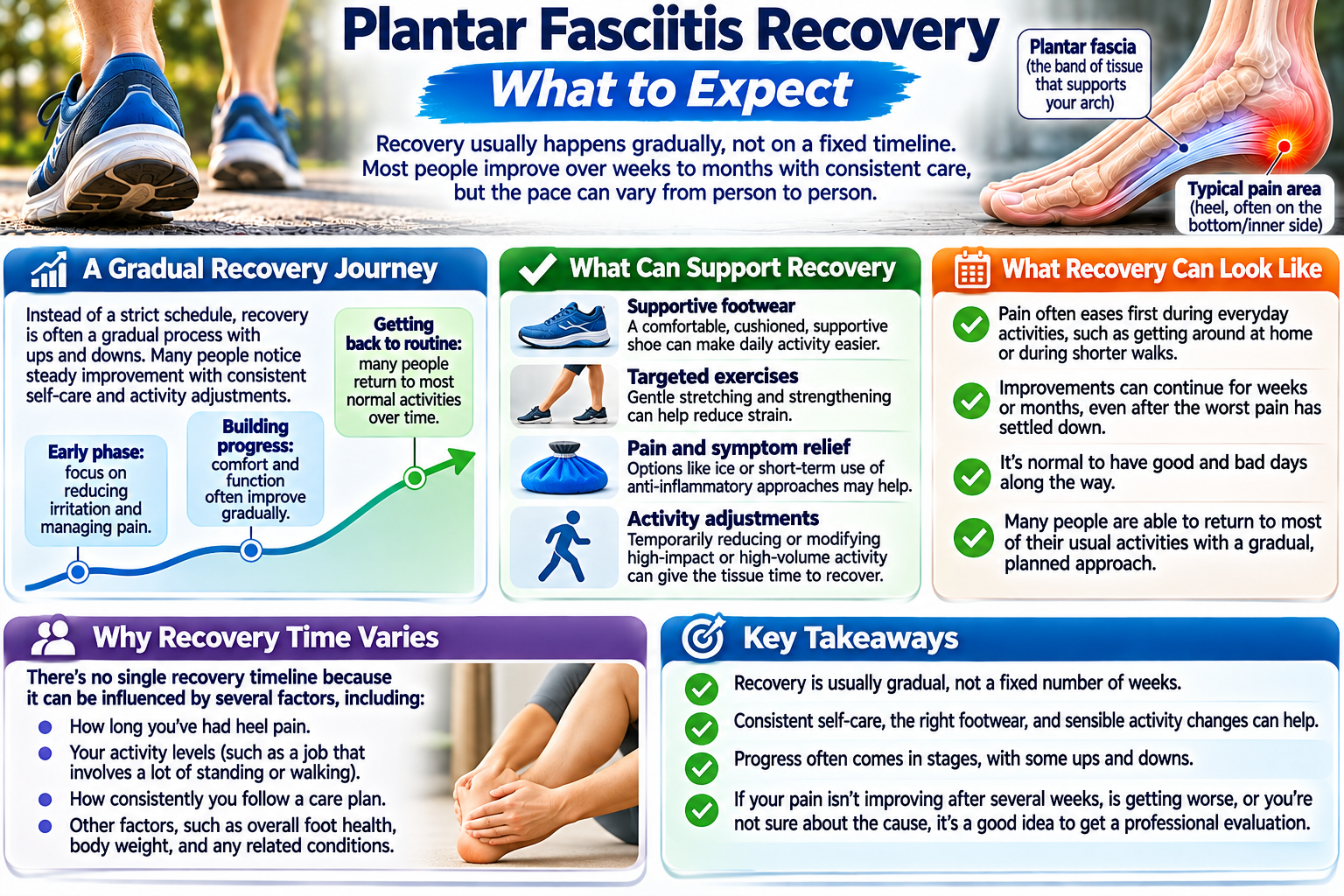
Most people improve without surgery, but improvement can take time. The American Academy of Orthopaedic Surgeons (AAOS) reports that more than 90% of patients improve within 10 months of beginning simple treatment. That number describes a broad group, not a countdown for your particular foot. Here's how to make sense of the months in between, especially when the good and bad days don't line up neatly.
How Long Does Plantar Fasciitis Recovery Take?
It's natural to want a date. If your heel has been hurting for six weeks, you may wonder whether you should be nearly finished recovering. If it's been six months, you may worry that nothing is working. Neither question can be answered from the calendar alone.
Some people feel meaningful relief within weeks. Others need months of consistent adjustments before everyday walking becomes comfortable again. Your starting symptoms matter, but so does what your week looks like. Someone who can temporarily cut back on running may be able to avoid a major source of irritation. A nurse, teacher, or warehouse employee might have to manage long hours standing while trying to recover. Those situations create different challenges, even when the diagnosis is the same.
The goal isn't simply to rest until the pain disappears. Recovery usually involves finding a manageable balance between movement and the activities that keep aggravating the heel. The AAOS treatment overview describes activity modification and stretching among common nonsurgical approaches. The 2023 plantar heel pain clinical practice guideline also addresses plantar fascia and calf stretching, foot and ankle strengthening, and education about managing physical demands.
A slow recovery doesn't automatically mean you've done something wrong. Still, a long duration isn't a reason to ignore pain that's getting worse or preventing you from living normally. Progress and the need for reassessment are separate questions, and both deserve attention.
Signs Your Plantar Fasciitis Is Improving
Pain is the first thing most people notice, but it isn't the only useful measure of recovery. A better way to judge progress is to look at how your heel behaves across a fairly ordinary week.
Perhaps your first steps are still uncomfortable, but the pain fades after a minute rather than lingering through breakfast. Maybe you can finish a shopping trip without looking for somewhere to sit, or your heel settles by the following morning after a demanding shift instead of staying sore for two days. These changes may be easy to overlook because none of them feels like a dramatic cure. Together, though, they can show that daily activities are becoming easier to tolerate.
Try keeping a brief note once or twice a week. Record how the first steps after waking felt, what walking or standing you managed, and how your heel responded later that day or the next morning. Use similar activities as points of comparison when possible. A five-minute walk and a day at an amusement park don't tell you the same thing about your progress.
You don't need a detailed spreadsheet or a perfect pain score. You're looking for a direction over several weeks: less disruption, more comfortable activity, and fewer prolonged flare-ups. One excellent morning can be misleading. So can one difficult one.
Why Plantar Fasciitis Pain Can Return During Recovery
Imagine you've had a better week and decide to do everything you've been putting off. You walk farther, spend more time on hard floors, and stand for several hours that evening. The next morning, your heel is sore again. That doesn't tell you precisely what happened inside the plantar fascia, but it does tell you that the demands of the day may have exceeded what your foot was comfortably handling.
The important distinction is between a temporary flare after an unusually demanding day and a pattern that is steadily moving in the wrong direction. If the pain settles after you return to a more manageable routine and your overall function is still improving, that is different from pain that begins earlier with every walk, keeps intensifying, or persists even when you're resting.
When a familiar activity triggers a flare, think back to what changed. Was the walk longer? Did you add hills? Were you standing in different shoes, or did several demanding activities happen close together? You may not be able to isolate one cause, and you don't need to. The point is to find a level of activity you can handle and build from there instead of repeatedly jumping from a good day into an exhausting one.
That doesn't mean complete rest is always necessary. The AAOS recommends reducing activities that worsen pain and describes lower-impact exercise, including cycling or swimming, as possible alternatives. If the pain is severe, follows an injury, or makes it difficult to bear weight, however, don't treat it as an ordinary flare. Get medical assessment.
Returning to Walking, Running, and Long Days on Your Feet
As symptoms improve, it's tempting to test your heel by doing the most you can manage. A more useful goal is to find an amount of activity you can repeat without repeatedly paying for it the following day.
For everyday walking, that might mean keeping your route shorter for a while, then adding distance once the current walk feels manageable during and afterward. You don't need to follow an arbitrary step-count target. If every longer walk leads to a much worse morning, the extra distance probably isn't helping you judge progress.
Running adds another layer because the impact and training demands can rise quickly. Someone who feels comfortable walking may still find that returning to previous running mileage brings symptoms back. Temporarily using lower-impact exercise can help maintain activity while you work toward a gradual return. If you compete, train regularly, or have repeated setbacks, a physical therapist can help tailor the progression rather than leaving you to guess.
Work is often the harder problem. A person who stands through an eight-hour shift cannot simply avoid every uncomfortable step. Small changes may be more realistic: alternating tasks when possible, sitting briefly during breaks, adjusting the amount of walking outside work, or wearing shoes that fit comfortably through the whole day. The 2023 clinical guideline includes education about managing physical loads as part of care.
The common principle is consistency. You're trying to make your normal life more tolerable, not win a one-day endurance contest. A good recovery plan should fit your actual responsibilities, whether those involve work, exercise, caring for children, or simply getting through errands.
What Helps Recovery Without Buying Everything at Once?
When recovery feels slow, shopping can seem like action. New shoes, custom orthotics, a night splint, and a collection of recovery gadgets all promise something different. Buying several things together, however, makes it difficult to tell which change mattered—and none is a substitute for understanding the problem.
A sensible foundation usually includes adjusting activities that repeatedly worsen symptoms, wearing footwear that is comfortable for your needs, and following an appropriate stretching and strengthening plan. The 2023 clinical practice guideline supports plantar fascia and calf stretching and foot and ankle resistance exercise. It also advises against relying on orthoses alone for short-term pain relief, although they may be useful as part of broader care.
That distinction matters when you're deciding what to buy. If your current shoes fit well and your heel is steadily improving, replacing them may not be necessary. If your shoes are uncomfortable or clearly aggravate symptoms, addressing that specific issue is more reasonable than assuming an expensive pair will automatically speed recovery. Night splints may be discussed for persistent first-step pain, but they aren't something everyone needs.
Our plantar fasciitis overview explains the broader condition and common treatment approaches. Detailed exercise instructions and product comparisons belong in their own guides; here, the priority is choosing a manageable plan and giving it a fair chance while monitoring how you're actually doing.
When Plantar Fasciitis Recovery Isn't Progressing
There is a difference between taking a long time to recover and having symptoms that should be reassessed. If you have been making reasonable adjustments but your pain is not improving, it may be time to check whether the diagnosis still fits, whether another condition is contributing, or whether your treatment plan needs to change.
You don't need to wait months to ask for help. The NHS plantar fasciitis guidance recommends medical advice when heel pain is severe, keeps returning, worsens, or has not improved after about two weeks of self-care. Tingling, numbness, and new foot pain in someone with diabetes also deserve medical attention. These recommendations are not a claim that everyone should recover in two weeks; they are reasons to avoid managing an uncertain or worsening problem indefinitely.
Get urgent assessment for serious pain after an injury, inability to bear weight, marked swelling, or signs of infection such as spreading redness with fever. Those symptoms are not typical recovery fluctuations.
For everyone else, a follow-up visit can be useful even when the problem isn't urgent. Tell the clinician what activities you can manage now compared with a few weeks ago, what repeatedly triggers pain, and what you've already tried. That gives them more to work with than saying the heel is simply 'still sore.'
How to Tell Whether Your Recovery Plan Is Working
At the end of a week, you don't need to ask whether every trace of pain has vanished. Ask whether ordinary life is getting a little easier. Can you manage the activities you need to do with less discomfort? Does your heel recover more quickly after a demanding day? Are the setbacks becoming less disruptive?
If the overall trend is improving, gradual progress may make sense. If one activity repeatedly causes a flare, consider adjusting that demand. If your function is declining, the pain is changing, or you're no longer confident the diagnosis explains your symptoms, arrange a reassessment instead of simply buying another product.
Recovery can be slow without being hopeless, and uneven without being meaningless. The goal is not to have a perfect morning every morning. It's to return to the things you need and enjoy doing with a foot that is becoming more reliable over time.